Max Basmanovs
Is GEO Really New? What SEO Professionals Actually Think About AI Search Optimization
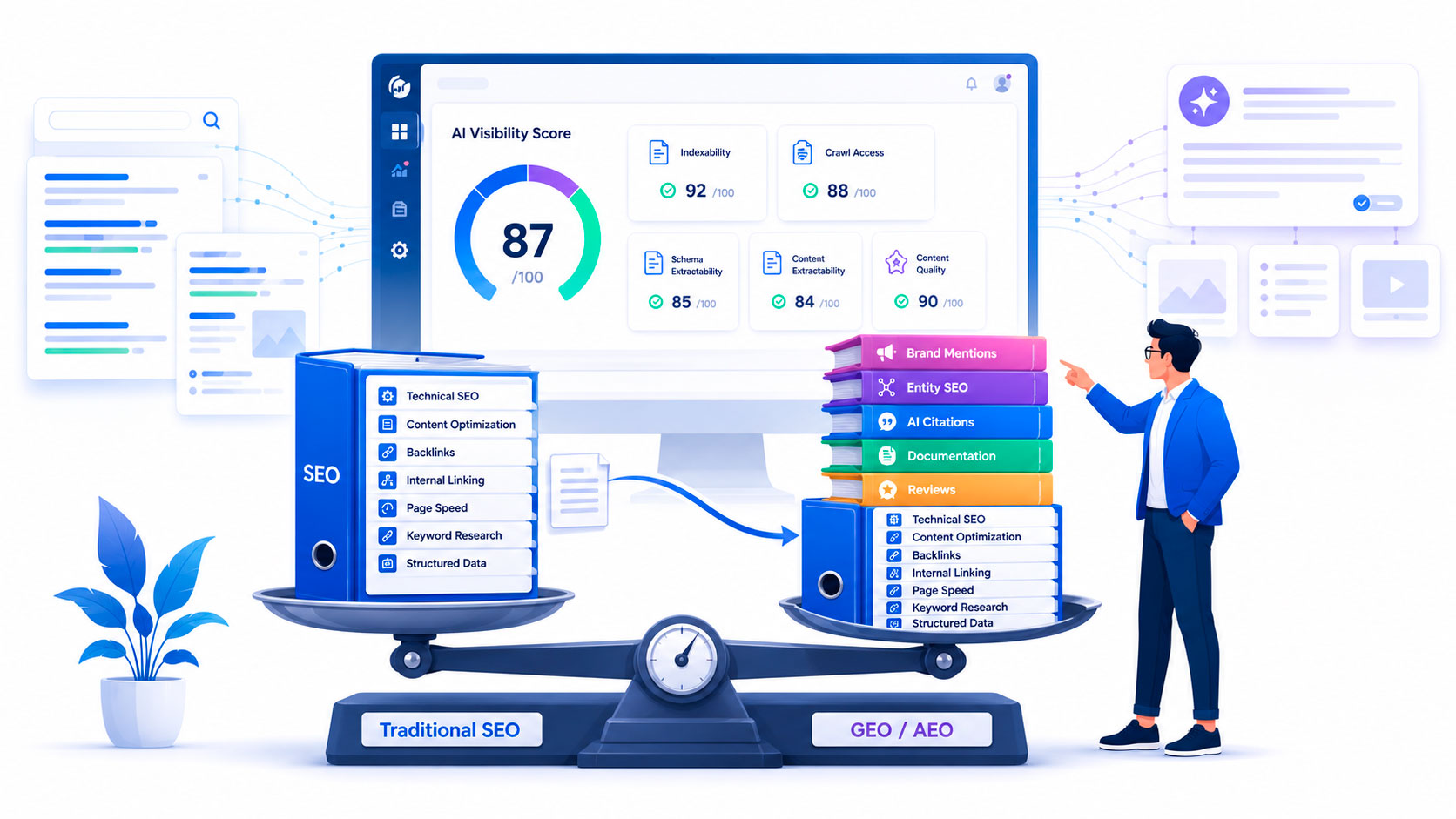
Over the past year, Generative Engine Optimization (GEO) and Answer Engine Optimization (AEO) have become some of the hottest buzzwords in digital marketing.
Almost every SEO agency now promises to optimize websites for ChatGPT, Gemini, Claude, Grok, Perplexity, and whatever AI platform comes next.
The marketing message is simple:
- Rank inside AI answers
- Increase AI referrals
- Become visible to large language models
- Future-proof your business against declining organic traffic
But is GEO actually a new discipline?
Or is it simply traditional SEO wrapped in a new name?
A recent discussion on Reddit attracted nearly one hundred comments from experienced SEO professionals. While opinions differed on the terminology, one conclusion appeared again and again:
Great SEO already does most of the work.
We largely agree.
However, there's an important nuance that often gets lost in the conversation.
AI visibility isn't magic, but it also isn't identical to Google rankings.
Modern AI systems must first discover your content, access it, understand it, extract useful information from it, and decide whether your brand is trustworthy enough to reference.
Those steps can be measured.
What the SEO Community Is Saying
The Reddit discussion started with a bold statement:
"AEO/GEO is bullshit. If your SEO is good, ChatGPT and Gemini will naturally recommend your content."
Many experienced practitioners agreed with the general idea.
Several admitted that when management asks about an "AI strategy," they simply present existing SEO initiatives under new terminology.
Instead of saying:
- improve internal linking
- fix structured data
- expand topical authority
- strengthen technical SEO
they present the same work as:
- GEO optimization
- AI visibility improvements
- Answer Engine Optimization
In many cases, the deliverables are identical.
Another recurring theme was that agencies have embraced GEO because businesses are actively searching for AI solutions. The demand is real, even if much of the work hasn't fundamentally changed.
That doesn't necessarily make GEO fake.
It simply means the industry has rebranded familiar practices to match changing expectations.
Where Traditional SEO and AI Visibility Overlap
Good SEO has always been about helping machines understand websites.
Search engines need to crawl pages, interpret content, identify entities, and evaluate trust before ranking anything.
Large language models face many of the same challenges.
If your website has technical issues, weak content, missing metadata, or inconsistent information, AI systems won't magically understand it better than Google does.
Technical SEO remains the foundation.
High-quality content remains essential.
Authority still matters.
But AI introduces a few additional considerations.
Where AI Visibility Is Different
Unlike a traditional search engine, an AI assistant doesn't simply rank documents.
It synthesizes information from multiple trusted sources to generate a single answer.
That means visibility depends not only on rankings but also on how easily your information can be extracted, interpreted, and trusted.
Brand mentions across the web become more valuable.
Clear factual statements become easier to quote.
Structured data becomes more useful.
Entity consistency matters more than ever.
These ideas aren't new.
Their importance has simply increased.
Measuring AI Visibility Instead of Guessing
At SEO Pilot, we believe AI optimization shouldn't rely on buzzwords.
It should rely on measurable signals.
That's why our AI Visibility Toolkit evaluates websites across five independent categories.
Instead of asking whether a website is "optimized for ChatGPT," we ask a much more practical question:
Can AI systems successfully discover, access, understand, extract, and trust your content?
1. Indexability
Before AI systems can reference your content, they first need to find it.
Indexability remains one of the strongest indicators of potential AI visibility.
Our analysis checks issues including:
- Pages missing from Google's index
- X-Robots-Tag noindex headers
- noindex meta tags
- Canonical conflicts
- Missing canonical URLs
A website with hundreds of excluded pages immediately limits both search visibility and AI discovery.
If your content isn't being indexed, AI assistants have significantly fewer opportunities to encounter it.
2. Crawl Access
Even indexed websites can create unnecessary obstacles for AI crawlers.
SEO Pilot evaluates factors such as:
- robots.txt restrictions
- AI-specific crawler blocking
- HTTPS availability
- HTTP response codes
- llms.txt availability
One increasingly common issue is websites unintentionally restricting AI crawlers through robots.txt rules.
Another is the absence of an llms.txt file, which is quickly becoming a useful way to guide AI systems toward important content.
These aren't ranking factors by themselves, but they improve discoverability and accessibility.
3. Schema Extractability
This is one area where AI systems benefit even more than traditional search engines.
Structured data gives machines explicit context.
Our toolkit evaluates whether important schema types are implemented correctly, including:
- Organization
- Article
- BlogPosting
- FAQ
- Person
- Service
- Product
- LocalBusiness
- ContactPage
Schema doesn't guarantee citations.
But it dramatically improves how easily AI systems interpret relationships between pages, organizations, authors, products, and services.
4. Content Extractability
Large language models don't read pages like humans.
They extract information.
Poor document structure makes that process much harder.
SEO Pilot analyzes signals including:
- Missing H1 headings
- Broken heading hierarchy
- Missing H2 sections
- Semantic HTML
- Missing language attributes
- Missing modification dates
- Meta descriptions
- Title tags
Well-structured content is easier to summarize, quote, and cite.
The goal isn't writing for robots.
It's removing unnecessary friction for both machines and people.
5. Content Quality
Content quality remains just as important in AI search as it has always been in SEO.
Thin pages rarely become authoritative sources.
Our toolkit looks for signals such as:
- Thin content
- Low text-to-HTML ratio
- Missing image alt attributes
- Weak page structure
- Title and H1 duplication
AI models are trained to identify useful, comprehensive, and trustworthy information.
Improving content quality benefits every discovery channel—not just AI assistants.
The Growing Importance of Brand Mentions
One insight from the Reddit discussion deserves particular attention.
Several experienced SEOs pointed out that brand mentions may become more important than backlinks alone.
AI systems gather information from many places:
- Documentation
- Review websites
- Industry blogs
- GitHub
- Community discussions
- Knowledge bases
A business consistently mentioned across trusted sources builds stronger entity recognition than one relying only on backlinks.
This doesn't replace link building.
It expands the definition of authority.
So... Is GEO Just SEO?
Mostly.
But not entirely.
The Reddit discussion is correct that many GEO services simply package traditional SEO under a fashionable label.
However, AI search has increased the importance of several areas that many businesses previously ignored:
- Structured data
- Machine-readable content
- Entity consistency
- Brand mentions
- Content extractability
Those aren't revolutionary concepts.
They're measurable improvements that help both search engines and AI systems understand your website.
The SEO Pilot Perspective
We don't believe there's a secret GEO formula.
Instead of chasing the latest acronym, we focus on improving measurable signals that directly affect AI visibility.
Our AI Visibility Toolkit analyzes hundreds of technical and content-related factors to calculate an overall AI Visibility Score based on:
| Category | Purpose |
|---|---|
| Indexability | Can search engines and AI discover your pages? |
| Crawl Access | Can AI crawlers reach your content? |
| Schema Extractability | Can machines understand your structured data? |
| Content Extractability | Can AI efficiently parse and summarize your pages? |
| Content Quality | Is your content authoritative and useful enough to reference? |
These signals don't just improve AI visibility.
They improve your website overall.
Key Takeaways
- GEO is not a replacement for SEO.
- Most GEO services are traditional SEO presented with new terminology.
- Technical SEO remains the foundation of AI visibility.
- AI systems benefit from structured, machine-readable content.
- Brand mentions across trusted sources are becoming increasingly important.
- Clear, factual writing is easier for AI assistants to quote.
- Measuring AI readiness is more valuable than chasing marketing buzzwords.
Final Thoughts
AI search is changing how people discover information, but it hasn't changed what makes information trustworthy.
Websites that are technically healthy, well-structured, authoritative, and consistently mentioned across the web are more likely to appear in both traditional search results and AI-generated answers.
Rather than asking whether you need SEO or GEO, ask a more useful question:
How easy is it for AI systems to discover, understand, and confidently reference your content?
That's exactly what the SEO Pilot AI Visibility Toolkit is designed to measure.